A Level Maths Trigonometry: Cambridge 9709 Pure 1 Complete Guide
- Trigonometry
- A Level Maths trigonometry in 9709 Pure 1 covers exact values, trigonometric graphs and transformations, solving equations, and applying the identities using sin²θ + cos²θ = 1 and tanθ = sinθ/cosθ. Topic 1.5 appears on every Paper 1, typically worth 10-15 marks directly. Getting full marks here isn't about memorisation — it's about having a systematic approach to finding all solutions and choosing the right method for each equation type.
Key takeaways
- Cambridge 9709 Pure 1 trigonometry covers radian measure, exact values, the identities sin²θ + cos²θ = 1 and tanθ = sinθ/cosθ, and solving equations in given intervals.
- Radians are compulsory throughout 9709. Using degrees where radians are required is one of the most frequently cited examiner errors in Cambridge 9709 examiner reports.
- The exact values for sin, cos, and tan at 0, π/6, π/4, π/3, and π/2 are not provided in the formula booklet — you are expected to derive or recall them.
- ExamPilot's adaptive practice identifies whether your trigonometry errors come from identity confusion, rounding mistakes, or equation-solving gaps — and targets each one separately.
This guide is part of our Complete Cambridge 9709 Pure 1 Revision Guide — your comprehensive resource for exam preparation.
What A Level Maths Trigonometry Covers in 9709 Pure 1
Trigonometry in 9709 Pure 1 uses radian measure throughout. It covers the identities sin²θ + cos²θ = 1 and tanθ = sinθ/cosθ, exact values at standard angles, and solving equations in given intervals.
Topic 1.5 in the 9709 Pure Mathematics 1 syllabus is more focused than most students expect. It covers:
- Graphs of sin, cos, and tan for angles of any size (degrees and radians)
- Exact values of sin, cos, and tan at 0°, 30°, 45°, 60°, 90°
- The identity sin²θ + cos²θ ≡ 1
- The identity tan θ ≡ sin θ / cos θ
- Solving trigonometric equations in a given interval
- Inverse trig notation: sin⁻¹x (arcsin), cos⁻¹x (arccos), tan⁻¹x (arctan)
What's NOT in Pure 1: compound angle formulae (sin(A+B), cos(A+B)), double angle formulae, sec, cosec, cot, and R-formulae. All of those are Pure 3. Don't revise them for Paper 1.
Trigonometry typically accounts for 10–15 marks directly on a 75-mark paper. But trig values also appear inside coordinate geometry and graph sketching questions, pushing the true contribution closer to 15–20 marks. That's roughly roughly a fifth to a quarter of your Paper 1 grade hinging on one topic.
Exact Values You Need to Know (And How to Never Forget Them)
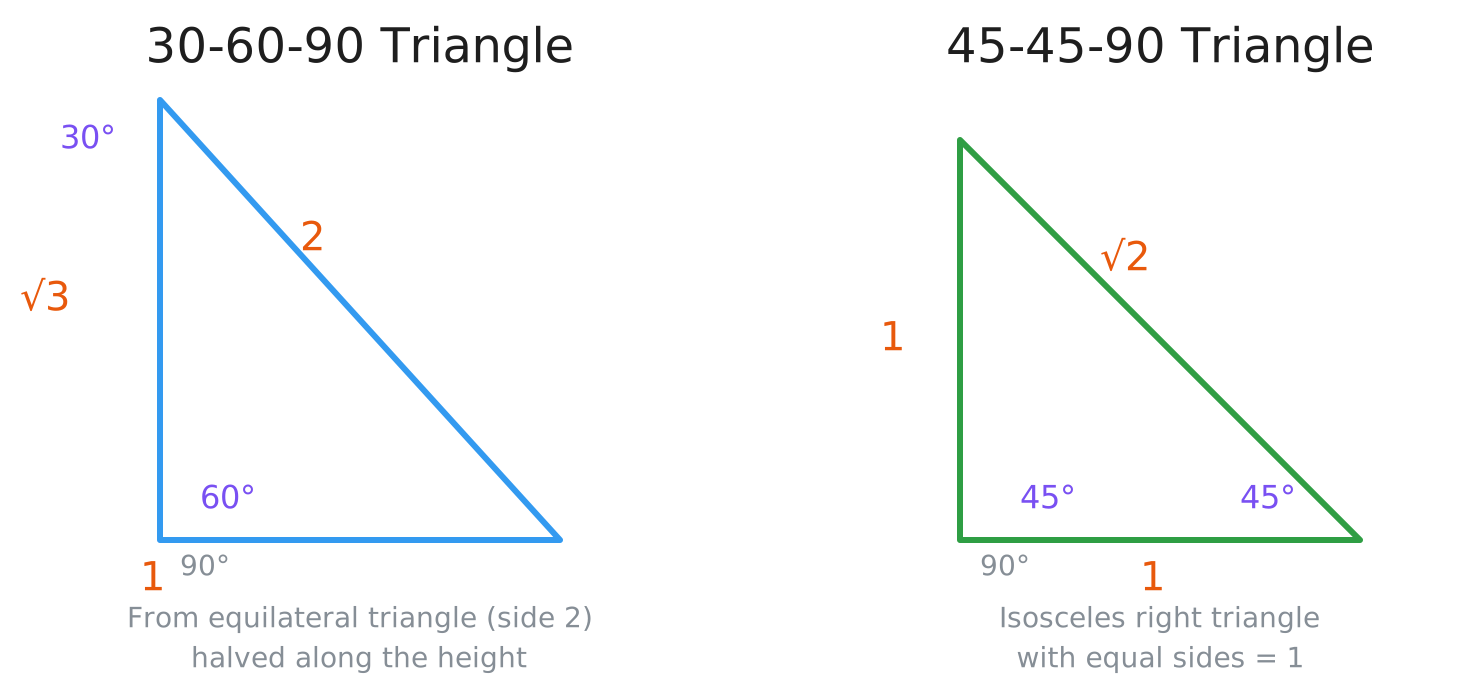
Take an equilateral triangle with side length 2. Cut it in half down the middle. You now have a right-angled triangle with hypotenuse 2, short side 1, and long side √3 (by Pythagoras). That gives you sin 30° = 1/2, cos 30° = √3/2, tan 30° = 1/√3 (= √3/3), and the 60° values by reading the other acute angle.
Take an isosceles right-angled triangle with equal sides of 1. The hypotenuse = √2. That gives sin 45° = 1/√2, cos 45° = 1/√2, tan 45° = 1.
Notice the pattern in the table: the sin column reads 0, 1/2, 1/√2, √3/2, 1. The cos column is the same values in reverse order. Once you see that, the table writes itself.
Sin Cos Tan Graphs and Transformations in A Level Maths
y = sin x starts at 0, rises to 1 at π/2, returns to 0 at π, falls to −1 at 3π/2, completes one cycle at 2π. Amplitude 1, period 2π. y = cos x starts at 1, same shape as sin x but shifted right by π/2. y = tan x (tangent) passes through the origin, has vertical asymptotes at π/2 + nπ for integer n (i.e. π/2, 3π/2, −π/2, …). No amplitude, period π.
Practise trigonometry with AI-powered questions calibrated to your level
ExamPilot identifies your weak spots and targets them with adaptive, exam-specific practice.
By joining, you agree to receive emails from ExamPilot. Unsubscribe any time.
Solving Trigonometric Equations and Proving Identities
Solving trigonometric equations a level students face in 9709 is where most marks are won and lost. The Cambridge examiner reports flag the same errors every year: students find one solution when three exist, or they divide by a trig function and lose half their answers.
When an equation contains both sin and cos (and at least one is squared), use sin²θ + cos²θ = 1 to convert everything to a single function. Some trig equations are quadratics in disguise — the giveaway is sin²θ or cos²θ alongside a linear sin θ or cos θ term. Let u = sin θ, factorise, solve, then find all angles.
Proving Trigonometric Identities
Proving trigonometric identities appears on most 9709 Paper 1 exams. The trigonometric identities a level exams test are surprisingly few — just two for Pure 1 — but identity proofs look intimidating until you have a system. Start with the complicated side, convert to sin and cos, look for the identity sin²θ + cos²θ ≡ 1, and work down one side only.
How Trigonometry Connects to Other 9709 Topics
A level maths trigonometry doesn't exist in isolation. The exact values feed into coordinate geometry questions involving gradients at specific angles.
Radians come from circular measure (Topic 1.4). If you're shaky on converting between degrees and radians, fix that before tackling trig equations in radians. The graph transformations here use the same rules covered in our functions guide, applied to sine and cosine curves instead of algebraic functions.
And while you won't differentiate or integrate trig functions in Pure 1, understanding trigonometric graphs helps you visualise rates of change when you reach differentiation and the area calculations in integration.
For the calculus topics that build on trig, see our differentiation guide and integration guide.
Summary
A level maths trigonometry in Cambridge 9709 rewards a systematic approach over memorisation. Derive your exact values from two triangles. Use the 3-step method for every equation. Prove identities by starting with the complicated side and converting to sin and cos. And never, under any circumstances, divide by a trig function.
The five examiner report mistakes covered in this guide account for the majority of lost marks in 9709 trigonometry questions. Fix those five habits, and you've already separated yourself from most candidates.
What to Do Next
A level maths trigonometry questions appear on every Paper 1. They're predictable, structured, and learnable. The next step is consistent, targeted practice — start with the sub-topic you find hardest and work through past paper questions by type until the method selection becomes automatic.
ExamPilot's adaptive practice identifies exactly which trig sub-skills you need to work on. If you keep finding only one solution, the system surfaces more multi-solution equations until the habit is fixed. Ask Sparky walks you through identity proofs step by step, asking guiding questions rather than giving answers.
Continue your Pure 1 revision with our differentiation guide or functions guide.
Key formulas
Exact Values
Most exact values trigonometry a level resources tell you to memorise this table. Instead, derive the entire thing from two triangles in about 30 seconds. Triangle 1: Take an equilateral triangle with side 2, cut it in half — you get a 30-60-90 triangle with sides 1, √3, 2. Triangle 2: An isosceles right triangle with equal sides of 1 gives hypotenuse √2 and the 45° values.
| Angle (°) | Angle (rad) | sin θ | cos θ | tan θ |
|---|---|---|---|---|
| 0° | 0 | 0 | 1 | 0 |
| 30° | π/6 | 1/2 | √3/2 | 1/√3 (= √3/3) |
| 45° | π/4 | 1/√2 | 1/√2 | 1 |
| 60° | π/3 | √3/2 | 1/2 | √3 |
| 90° | π/2 | 1 | 0 | undefined |
Trigonometric Identities (Pure 1)
These are the only two identities you need for 9709 Pure 1. Compound angle formulae (sin(A+B), etc.) are Pure 3. Don't revise them for Paper 1.
Worked examples
Exact values
Simple trig equation
Quadratic trig equation
Identity proof
Graph transformation
Common mistakes
Finding only one solution when the question asks for all solutions in a given domain (e.g., 0 ≤ θ ≤ 2π)
After finding the principal value, use symmetry (sin is symmetric about π/2, cos about π) or the CAST diagram to find ALL solutions. Then check each one is within the given domain. Cambridge examiner reports have noted that a common error is to find only one solution for sin θ = 1/2, without recognising that sin is positive in both the first and second quadrants. (2023)
Dividing both sides of an equation by sinθ or cosθ, losing solutions where that function equals zero
Never divide by a trig function — factorise instead. sinθ cosθ = sinθ becomes sinθ(cosθ − 1) = 0, giving sinθ = 0 OR cosθ = 1. Dividing by sinθ would lose all the sinθ = 0 solutions. Cambridge examiner reports have observed that candidates who divided by sinθ invariably lost solutions and could not gain full marks. (2022)
Using incorrect identities under exam pressure — writing sinθ = 1 − cosθ instead of sin²θ + cos²θ = 1
The identity is sin²θ + cos²θ = 1, NOT sinθ + cosθ = 1 or sinθ = 1 − cosθ. Write the correct identity on your formula sheet before the exam starts. When you need to eliminate a function, rearrange: sin²θ = 1 − cos²θ or cos²θ = 1 − sin²θ. Examiner reports have noted that a number of candidates incorrectly used the identity without the squared terms, leading to incorrect simplifications. (2023)
Calculator in degrees when the question gives the domain in radians (or vice versa)
Check your calculator mode FIRST. If the domain is 0 ≤ θ ≤ 2π, you need radians mode. If it's 0° ≤ θ ≤ 360°, you need degrees mode. This error gives completely wrong answers and costs all the marks. Examiner reports have noted that some candidates clearly had their calculators in the wrong mode, producing decimal answers such as 0.524 instead of π/6. (2024)
Not showing working when solving trig equations — writing only the final answer from a calculator
Examiners need to see your method: the principal value, how you found additional solutions (symmetry/CAST/periodicity), and that you checked the domain. Writing just the answers — even if correct — loses method marks. Examiner reports have stated that candidates who presented only final answers without showing the method used to find all solutions in the given range could not be awarded method marks. (2024)
Exam tips
The 3-Step Method for Solving Trig Equations
- Get to a single trig function. If the equation has both sin and cos, use an identity to convert. If it's already a single function (sin θ = 1/2), skip to Step 2.
- Find the principal value. Use your calculator (inverse sin, cos, or tan) or exact values to find the first solution.
- Find ALL solutions in the domain. This is the step students skip. Use the CAST diagram or symmetry properties to identify every solution within the given interval. Pure 1 asks for solutions in a given interval, not the general solution — that's Pure 3.
Which Method Do I Use?
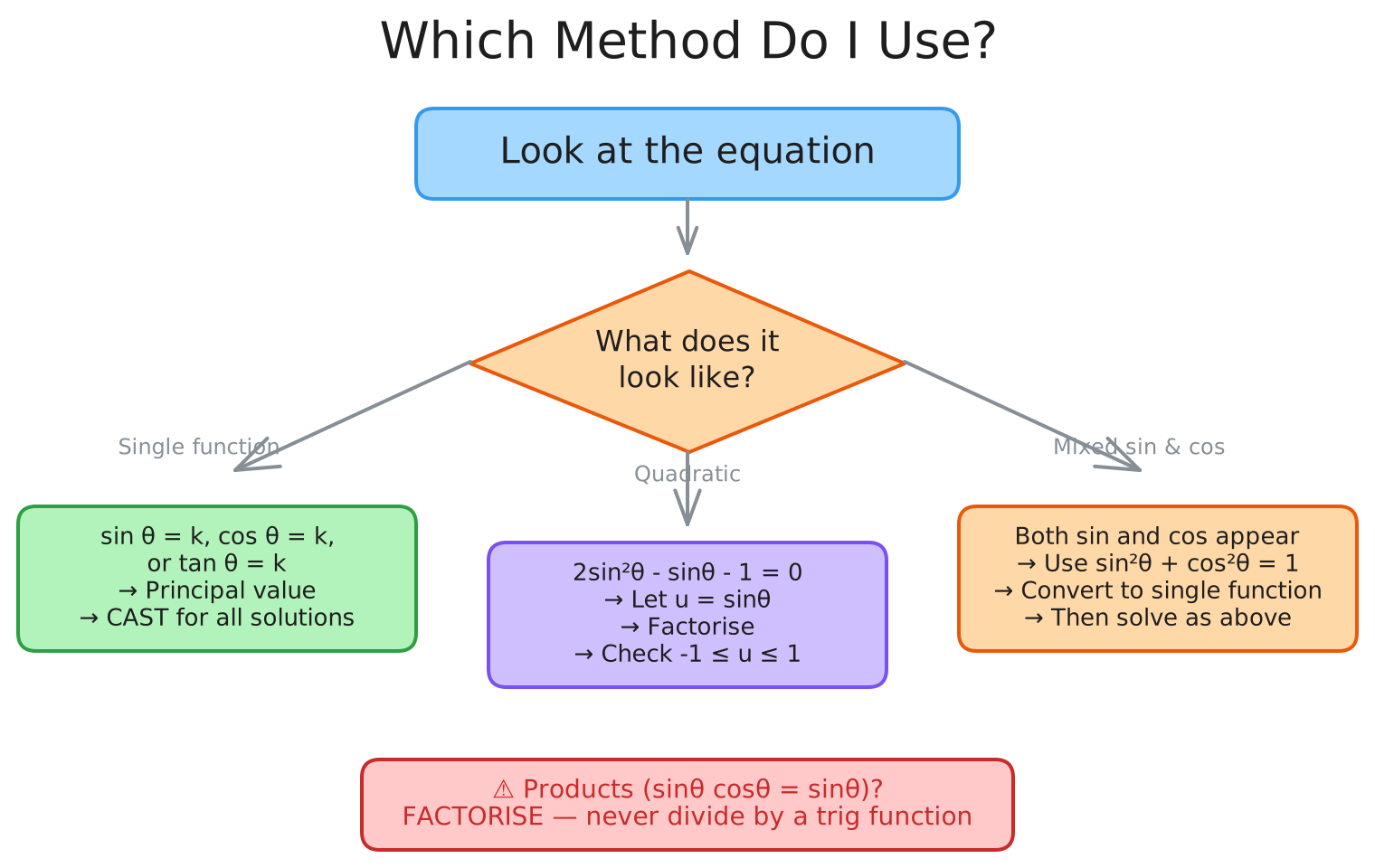
| Equation Type | Example | Method |
|---|---|---|
| Single function | sin θ = 0.5 | Principal value → CAST/symmetry for all solutions |
| Quadratic in disguise | 2sin²θ − sinθ − 1 = 0 | Let u = sinθ, factorise, solve, check validity |
| Mixed sin and cos (one squared) | 2cos²θ + sinθ = 1 | Use sin²θ + cos²θ = 1 to convert to single function |
| Mixed sin and cos (products) | sinθcosθ = sinθ | Factorise — NEVER divide by a trig function |
Never Divide by a Trig Function
Proving Identities: The 4-Rule Approach
- Start with the more complicated side. Pick the side with more terms, fractions, or mixed functions. Work that side until it matches the other.
- Convert everything to sin and cos. Replace tan θ with sin θ / cos θ. This gives you a common language to work with.
- Look for sin²θ + cos²θ = 1. After combining fractions or expanding, this identity usually appears. It's the key simplification step in most Pure 1 proofs.
- Work down one side only. Never write LHS = RHS as your starting line. That assumes what you're trying to prove. Start with one side and transform it step by step until it equals the other side.
The CAST Diagram
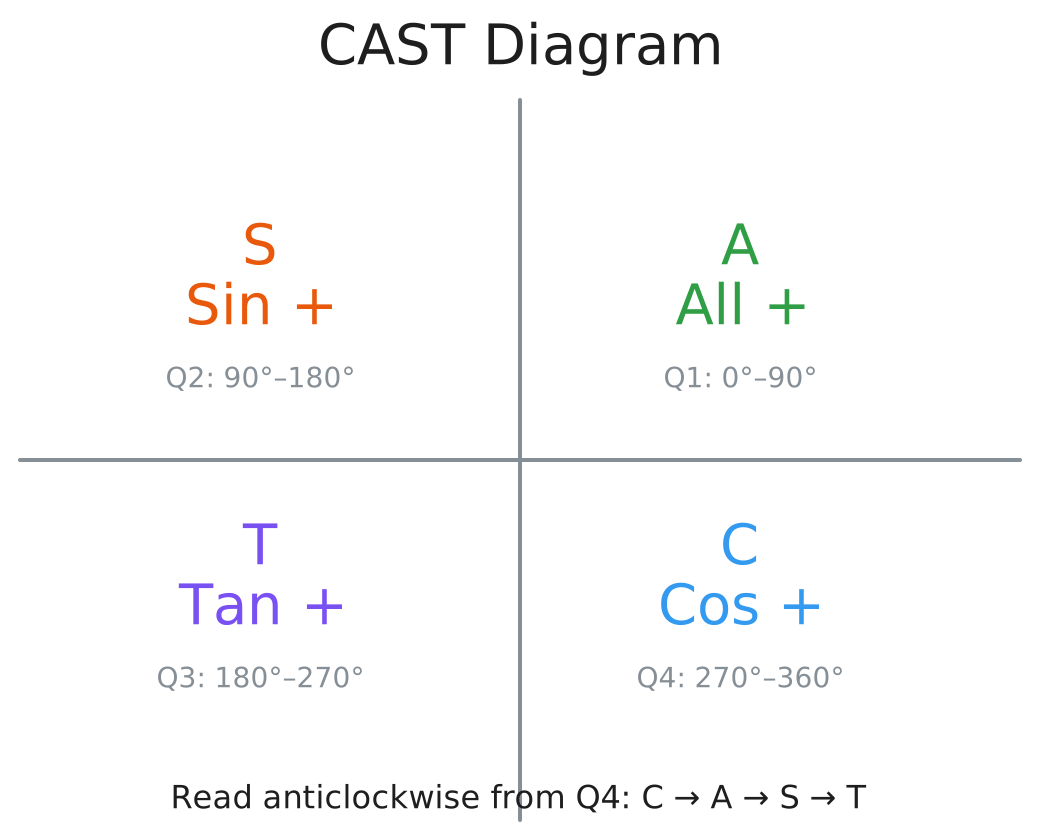
The CAST diagram tells you which trig functions are positive in each quadrant. Reading anticlockwise from the fourth quadrant: Cos, All, Sin, Tan. If sin θ = , sin is positive in Q1 and Q2, giving you θ = π/6 and θ = π − π/6 = 5π/6.
Graph Transformations for Trig Functions
The function y = a sin(bx + c) + d transforms y = sin x in four ways. The same rules from graph transformations in the functions topic apply here: a controls vertical stretch (amplitude becomes |a|), b controls horizontal stretch (period becomes 2π/b), c creates a phase shift of c/b, and d shifts vertically. The order matters — apply transformations inside the function first (horizontal), then outside (vertical).
| Parameter | Effect | Direction |
|---|---|---|
| a | Vertical stretch, scale factor a | As expected |
| b | Horizontal stretch, scale factor 1/b (changes period to 2π/b) | Opposite |
| c | Horizontal shift (phase shift) by c/b | Opposite |
| d | Vertical shift by d (up if d > 0, down if d < 0) | As expected |
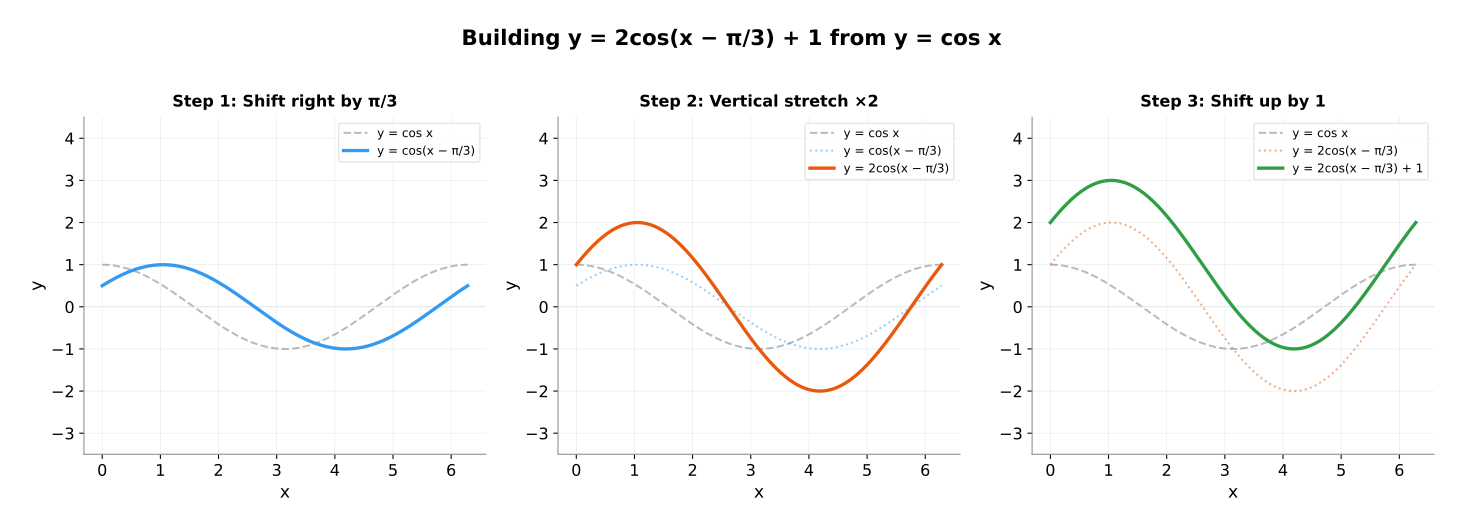
Worked example: Sketch y = 2cos(x − π/3) + 1. Step 1: Start with y = cos x. Step 2: Replace x with (x − π/3) — shifts right by π/3. Step 3: Multiply by 2 — amplitude becomes 2. Step 4: Add 1 — centre line moves to y = 1. Result oscillates between −1 and 3, with period 2π.
3-Stage Revision Strategy
Stage 1 (2-3 sessions): Master exact values and graph shapes. Derive the values from the two triangles until it's automatic. Sketch sin, cos, and tan from memory.
Stage 2 (3-4 sessions): Equation-solving techniques. Do past paper trig equations by type: simple, quadratic, identity-based. Use the flowchart until the method selection becomes instinctive.
Stage 3 (ongoing): Timed mixed practice. Combine all sub-topics under timed conditions. The real exam mixes equation-solving with graph interpretation and identity proofs.
Frequently asked questions
Practise trigonometry with AI-powered questions calibrated to your level
ExamPilot identifies your weak spots and targets them with adaptive, exam-specific practice.
No spam — just your invite.
By joining, you agree to receive emails from ExamPilot. Unsubscribe any time.