A Level Maths Differentiation: Cambridge 9709 Pure 1 Guide
A Level Maths differentiation is the topic that keeps showing up where you don't expect it in 9709 Paper 1. You see it labelled as a calculus question, but it's also hiding inside coordinate geometry problems, optimisation word problems, and rates of change questions. The rules are straightforward — the power rule takes 30 seconds to learn, the chain rule follows a clear pattern once you've seen a few examples. The real difficulty isn't the mechanics, it's knowing how to apply them when the question doesn't look like a textbook exercise.
This guide is part of our Complete Cambridge 9709 Pure 1 Revision Guide — your comprehensive resource for exam preparation.
What A Level Maths Differentiation Covers in 9709 Pure 1
Differentiation finds the gradient of a curve at any point. A straight line has a constant gradient. A curve doesn't — the steepness changes as you move along it. Differentiation gives you a formula for that changing gradient.
What's in scope for Paper 1
The Cambridge 9709 differentiation syllabus for Pure 1 (1.7) covers:
- The idea of a derived function; differentiation of power functions and simple polynomials
- The chain rule for differentiating composite functions of the form [f(x)]ⁿ, where the inner function f(x) is a polynomial expression — not just a linear term like (ax + b)
- Applications: gradients, tangents and normals, stationary points and their classification using the second derivative, increasing and decreasing functions, connected rates of change, practical maxima and minima, and sketching curves using stationary point information.
What's not in Pure 1: the product rule, the quotient rule, differentiating trigonometric or exponential functions, implicit differentiation, or points of inflexion. Those are Pure 3.
Differentiation questions directly carry 15–20 marks out of 75 on Paper 1. But the true figure is higher — coordinate geometry questions require tangent gradients, and optimisation problems need differentiation. When you account for these, a level maths differentiation contributes 30–35% of Paper 1 marks.
The A Level Maths Differentiation Rules
Every differentiation question in Pure 1 uses the power rule. Bring the power down as a multiplier, reduce the power by one. Before differentiating, convert roots and fractions into power notation.
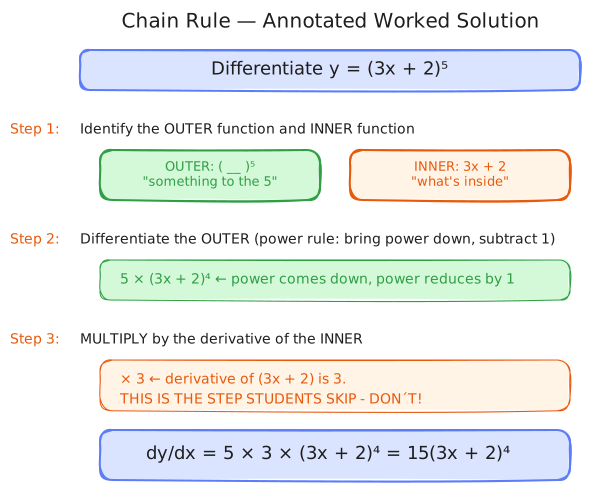
The chain rule handles composite functions — expressions where one function sits inside another. In Pure 1, the inner function will always be a polynomial — so you might see something like (x² + 3)⁵ as well as the simpler (ax + b)ⁿ form. Bring the power down as usual, then multiply by the derivative of what's inside the brackets.
Applying Differentiation in 9709 Exams
This is where students who know the rules still lose marks. Tangent and normal questions, stationary points in a level maths, connected rates of change in a level maths, and optimisation problems all require you to apply differentiation in context.
How Differentiation Connects to Integration
Differentiation and integration are reverse processes. If differentiating gives you the gradient function, integrating brings you back to the original function. Understanding this connection is fundamental — the integration guide covers the other half of calculus.
Summary
A level maths differentiation isn't just one topic on 9709 Paper 1 — it's the foundation for almost half the marks. The rules are quick to learn. The application takes practice. And the exam traps are predictable if you know what to look for.
Start with the sub-topic you find hardest. If the chain rule confuses you, do 10 questions until the method is automatic. If optimisation trips you up, practise the setup before worrying about the calculus.
What to Do Next
You now have the rules, the decision framework, the examiner insights, and the worked examples. The next step is consistent, targeted practice. ExamPilot's adaptive practice identifies your weakest differentiation sub-skills and targets them with questions matched to your level — no more random past paper grinding.
Looking for past paper practice? See our 9709 Past Papers by Topic collection.
Once you've got differentiation locked in, integration is the natural next step — see our 9709 Integration Guide to complete the picture.
For the trigonometry foundations you'll need when trig appears in calculus, see our Pure 1 Trigonometry Guide.
Differentiation uses function notation throughout — if you want to strengthen your understanding of domain, composite functions, or the chain rule connection to fg(x), our 9709 Functions Guide covers all of it.
Key Formulas
Power Rule
This works for any power — positive, negative, or fractional. But you must have the expression in power form first. Convert roots and fractions: √x = x½, 1/x³ = x⁻³.
Chain Rule (Pure 1)
For a linear inner function like (ax + b), the derivative of the inside is just a — making this the simplest case. In Pure 1 you may also see polynomial inner functions like (x² + 3)⁵, where you'll need to find the derivative of the inside first.
First Principles
Tangent and Normal Gradients
Stationary Points
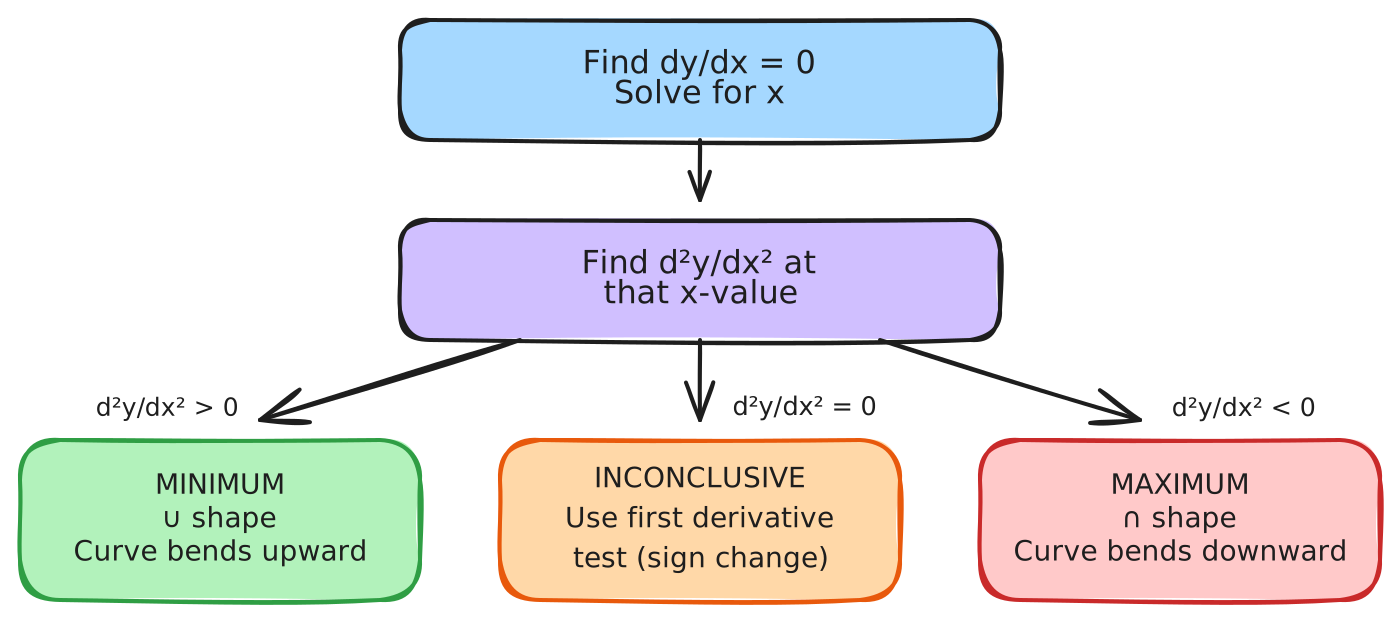
First find where dy/dx = 0 — that's your stationary point. Then use the second derivative to find out what kind it is.
Worked Examples
Basic power rule
Rewriting roots and fractions
Chain rule
First principles
Tangent and normal at a point
Stationary points classification
Connected rates of change
Optimisation
Common Mistakes
Not converting to power notation before differentiating — trying to differentiate √x or 1/x² directly
Convert roots and fractions to power form first: √x = x½, 1/x² = x⁻². You cannot apply the power rule to √x directly. Write the conversion step separately — don't skip it.
Sign errors with negative and fractional powers — writing -2x⁻¹ instead of -2x⁻³ when differentiating x⁻²
Bring the power down as the multiplier, then subtract one from the power. For x⁻²: multiplier is -2, new power is -2 − 1 = −3. So the derivative is −2x⁻³. Cambridge examiner reports consistently flag this as one of the most common sources of lost marks in 9709 Paper 1.
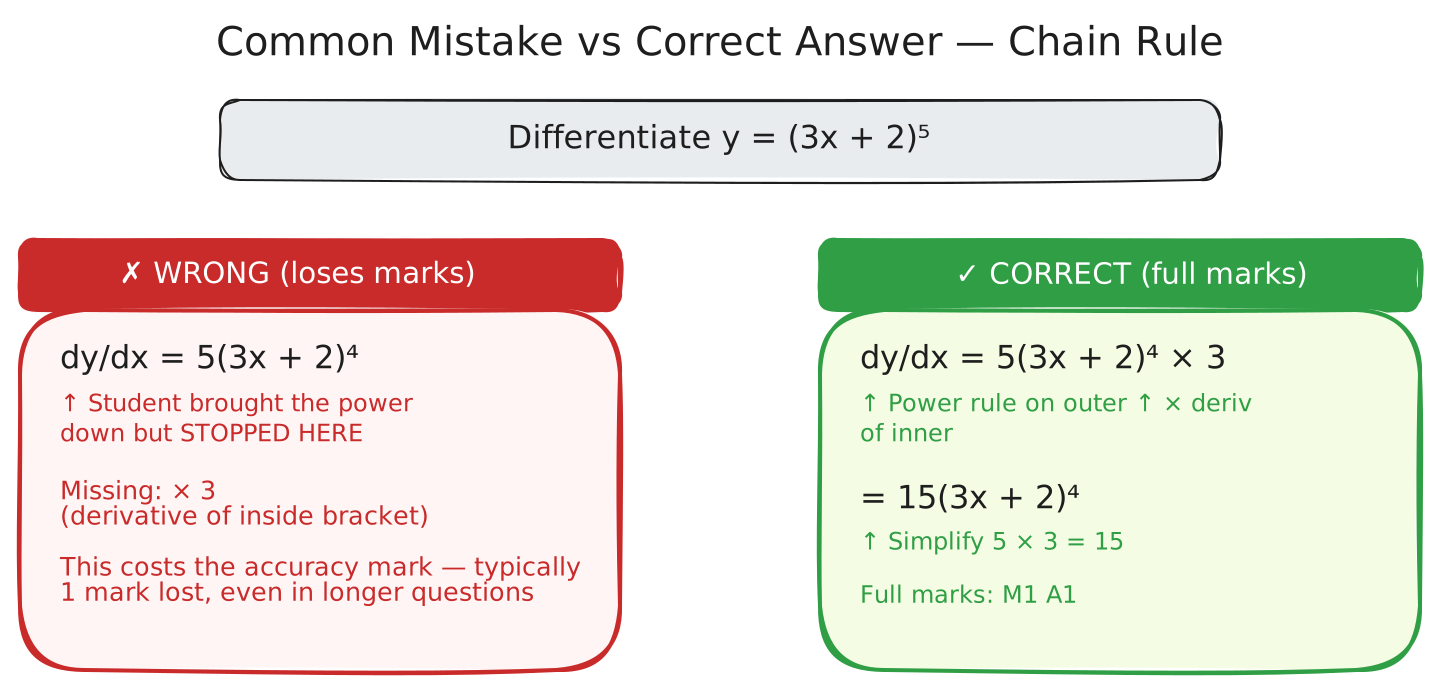
Forgetting the chain rule multiplier — differentiating (3x+2)⁵ as 5(3x+2)⁴ instead of 15(3x+2)⁴
After bringing the power down and reducing it, you must multiply by the derivative of the bracket contents. For (3x+2), the derivative of the inside is 3. Always write the chain rule multiplier explicitly before simplifying.
Not showing sufficient working in 'show that' questions — jumping straight to the answer
In first principles questions, examiners need to see every step: the expansion of f(x+h), the subtraction f(x+h)−f(x), the division by h, and the limit as h→0. Writing just the final result scores zero method marks even if correct.
Mixing up tangent and normal gradients — using 1/m instead of -1/m for the normal
The tangent gradient is dy/dx at the point. The normal gradient is the NEGATIVE reciprocal: -1/(dy/dx). If the tangent gradient is 8, the normal gradient is -1/8, not 1/8 and not -8.
Exam Tips
Which Differentiation Rule Do I Use?
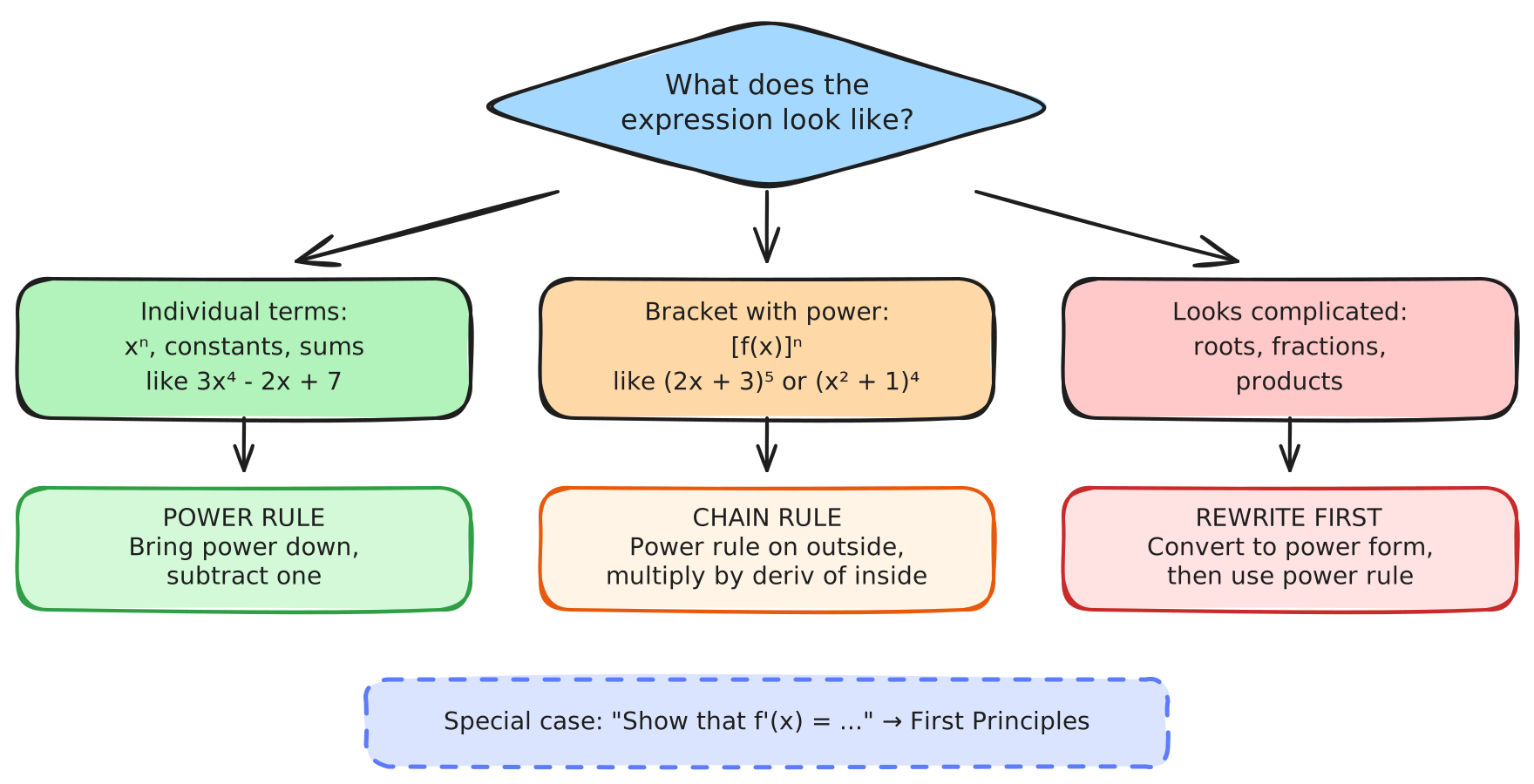
| Expression Type | Rule | Example | Key Step |
|---|---|---|---|
| Simple powers of x | Power rule | y = 3x⁴ − 5x² | Bring power down, reduce by one |
| Polynomial bracket with power: [f(x)]ⁿ | Chain rule | y = (3x + 2)⁵ | Also multiply by derivative of bracket |
| Roots or fractions | Rewrite + power rule | y = 4√x + 6/x² | Convert to power form first |
| 'Show that' from definition | First principles | Show d/dx(x³) = 3x² | Expand f(x+h), subtract, divide by h, limit |
For 9709 Pure 1, you only need two rules: the power rule and the chain rule. If a question looks like it needs the product rule, it's asking you to expand first and differentiate term by term.
Setting Up Tangent and Normal Questions
Two errors cost marks every year. First: forgetting to find the y-coordinate — students find the gradient then try to write the equation without knowing the point. Second: mixing up tangent and normal gradients. The tangent uses the gradient directly. The normal uses the negative reciprocal.
First Principles Method
- Write out f(x + h) by substituting (x + h) everywhere you see x
- Compute f(x + h) − f(x)
- Divide by h
- Cancel h from every term
- Let h → 0
Connected Rates of Change
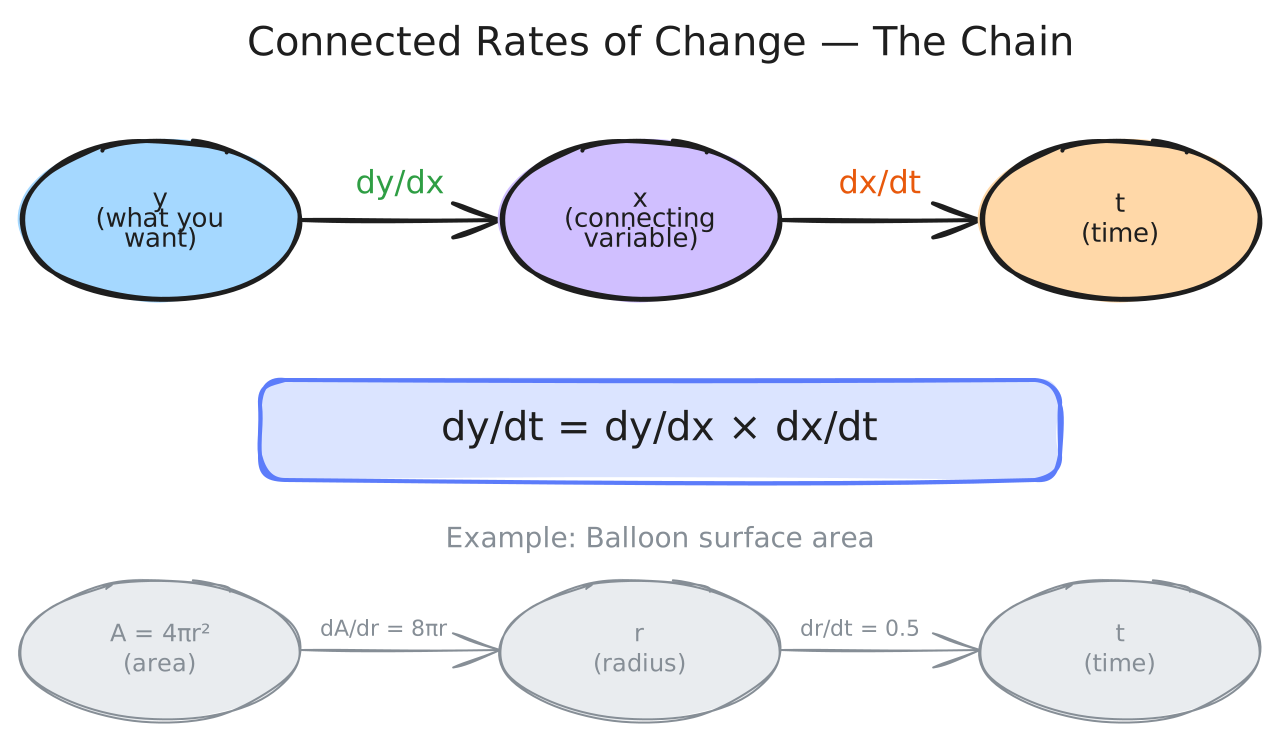
Connected rates of change questions ask you to find how one quantity changes with respect to another, using the chain rule to connect them. The key: identify the chain of variables and find each derivative separately, then multiply using the chain rule.
3-Stage Revision Strategy
Stage 1 — Learn the rules (Days 1–3). Focus on the power rule and chain rule. Don't touch applications yet.
Stage 2 — Practice by sub-topic (Days 4–10). Work through: basic differentiation, chain rule, first principles, tangents and normals, stationary points, connected rates of change, optimisation. Five to eight questions per sub-topic.
Stage 3 — Exam simulation (Days 11+). Practice full differentiation questions under timed conditions using past papers. Mark your work using the official mark scheme.
Practice differentiation with AI-powered questions calibrated to your level
ExamPilot identifies your weak spots and targets them with adaptive practice.
Join the WaitlistFrequently Asked Questions
Reviewed by
AI-assisted, human-reviewed