A Level Maths Series: Binomial Expansion, AP & GP for Cambridge 9709 Pure 1
A Level Maths series covers binomial expansion for positive integer n, arithmetic progressions (AP), and geometric progressions (GP) including sum to infinity. Topic 1.6 of the Cambridge 9709 Pure 1 syllabus tests Pascal's triangle, the general binomial term ⁿCᵣ, nth term and sum formulae for AP and GP, and the convergence condition for infinite geometric series. Series typically accounts for 7-10 marks out of 75 on Paper 1, with binomial expansion appearing every session.
This guide is part of our Complete Cambridge 9709 Pure 1 Revision Guide — your comprehensive resource for exam preparation.
Series questions in Cambridge 9709 follow two distinct patterns. Binomial expansion asks you to apply a formula with precision — get one coefficient wrong and every term after it collapses. Arithmetic and geometric progression questions ask you to build equations from conditions — and students who can't set up the simultaneous equations lose the entire question.
This guide covers everything in the Series topic of the Cambridge 9709 Pure Mathematics 1 syllabus. Binomial expansion is a mechanical skill. Sequences and series are a problem-solving skill. You need both, and they appear on Paper 1 every single session.
What Series Covers in 9709 Pure 1
What's in scope for Paper 1
- Binomial expansion of (a + b)ⁿ for positive integer n only
- Binomial coefficients using Pascal's triangle and the ⁿCᵣ notation
- Arithmetic progressions: nth term and sum of first n terms
- Geometric progressions: nth term, sum of first n terms
- Sum to infinity of a convergent geometric series (|r| < 1)
What's NOT in Pure 1: binomial expansion with fractional or negative n, and the infinite series expansion of (1 + x)ⁿ when n isn't a positive integer. That's all Pure 3 content. Don't revise it for Paper 1.
Understanding Binomial Expansion Visually
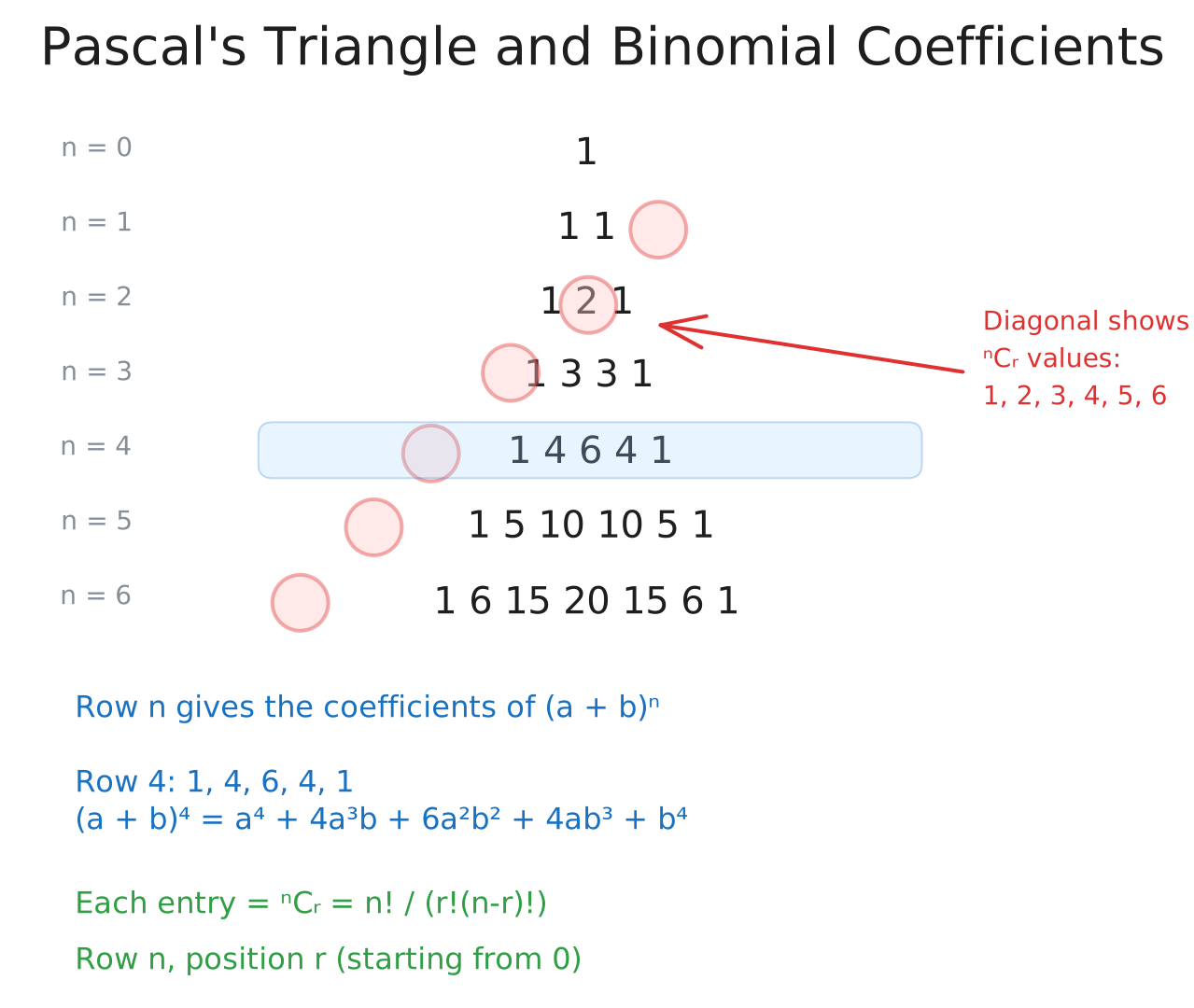
Pascal's triangle gives you the coefficients for expanding (a + b)ⁿ. Each row starts and ends with 1, and every interior entry is the sum of the two entries directly above it. For small values of n (up to about 6), Pascal's triangle is the fastest route to a full expansion.
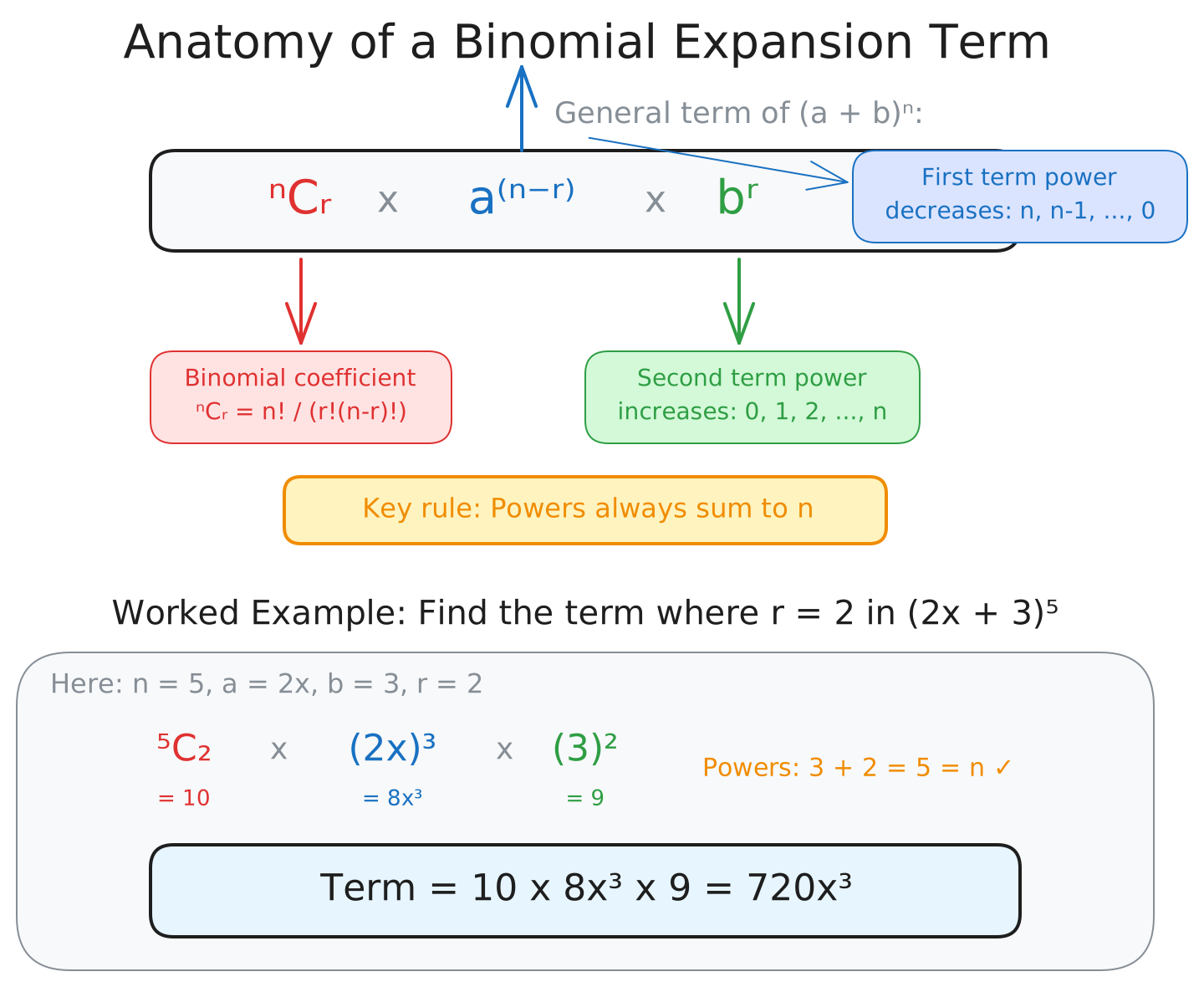
The general term formula is essential when you need a specific coefficient rather than the full expansion. The annotated diagram below breaks down every component of a single binomial term — and shows why forgetting to raise both bases to the correct power is the most common error.
Convergence of Geometric Series
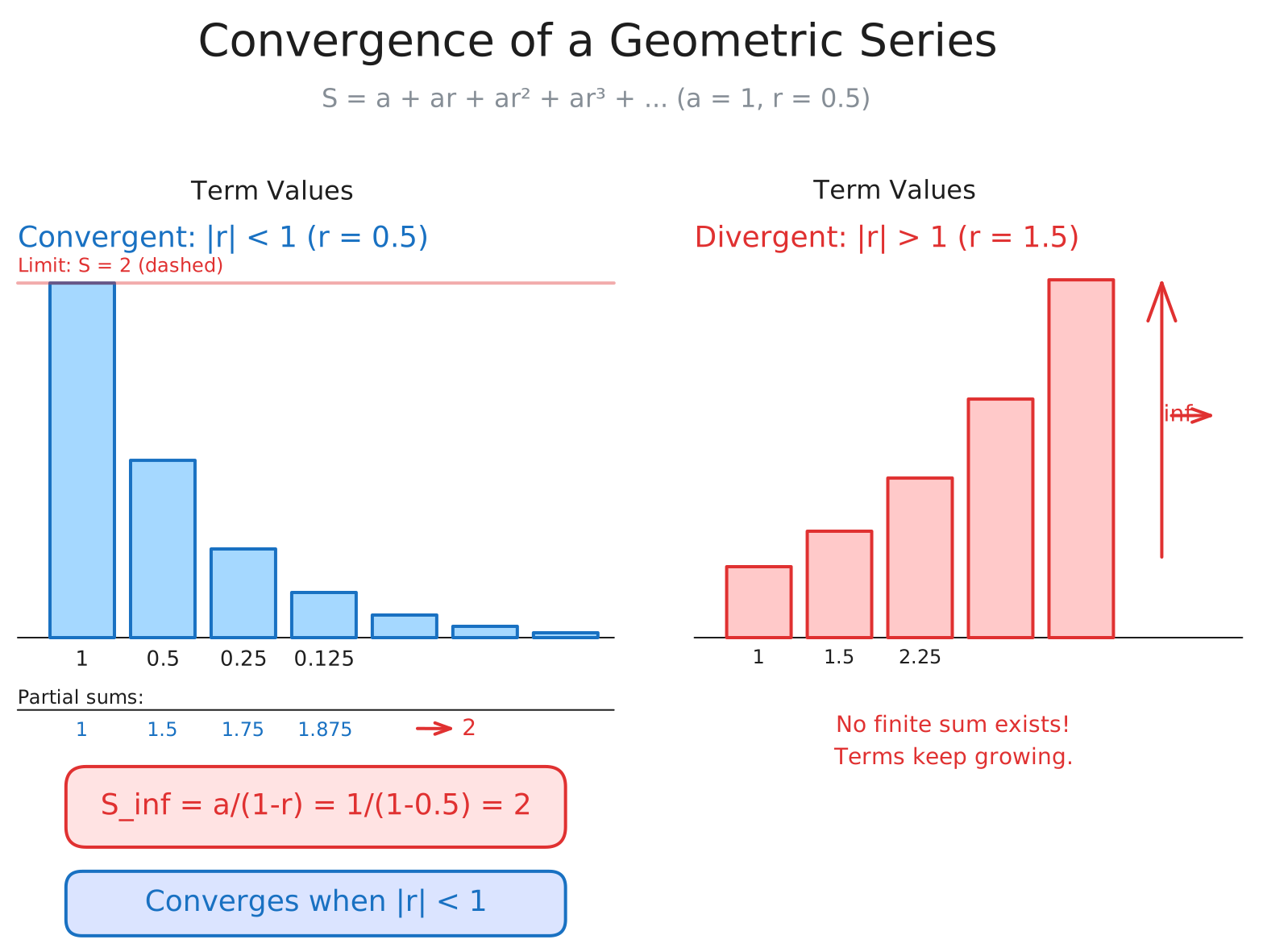
When |r| < 1, each successive term gets smaller. The partial sums approach a fixed value -- that's the sum to infinity. When |r| >= 1, the terms don't shrink. The partial sums grow without bound (or oscillate), and no finite sum exists.
How Series Connects to Other Topics
Binomial expansion questions sometimes involve simplifying expressions that lead to quadratics, or require you to equate coefficients and solve. See our 9709 quadratics guide for solving techniques.
Trigonometric identities occasionally appear alongside series in Paper 1 — especially in questions combining angle relationships with sequences. See our 9709 trigonometry guide for exact values and identities.
What to Do Next
Series in Cambridge 9709 Pure 1 splits into two skills. Binomial expansion rewards mechanical precision — track your coefficients, handle negative signs carefully, and set up the general term correctly for 'find the coefficient' and 'term independent of x' questions. AP and GP questions reward equation-building — translate the conditions into simultaneous equations, solve for a and d (or a and r), then answer whatever the question asks.
Start with the sub-topic you find hardest. If binomial expansion trips you up, drill coefficient-finding questions until the process is automatic. If AP/GP word problems confuse you, practise translating conditions into equations — the algebra is the easy part.
ExamPilot's adaptive practice identifies exactly which series sub-skills you need to work on. Instead of grinding through random questions, you practise the ones that target your specific gaps in binomial expansion, AP, or GP — with Ask Sparky available to guide you when you're stuck.
Ready to practise series questions with adaptive difficulty? Join the ExamPilot waitlist for AI-powered A-Level Maths practice.
Looking for past paper practice? See our 9709 Past Papers by Topic collection.
Next topic: 9709 Circular Measure Guide — radians, arc length, and sector area.
Key Formulas
Binomial Expansion (Positive Integer n)
Each term uses Pascal's triangle or ⁿCᵣ for the coefficient. For 9709 Pure 1, n is always a positive integer, giving a finite number of terms. Fractional and negative n belong to Pure 3 and produce infinite series — do not use them in Paper 1.
General Term of a Binomial Expansion
When the question says 'find the coefficient of x³', identify which value of r gives x³ in the general term, then calculate that single term. You don't need the full expansion — just the one term that matches. State the coefficient as a number — if the question asks for the coefficient of x³, the answer is the number in front of x³, not the full term.
Binomial Coefficient
This is the number of ways to choose r items from n. It appears in every term of the binomial expansion. For small n, read it directly from Pascal's triangle. For larger n, use the formula or your calculator's ⁿCᵣ function.
Arithmetic Progression (AP)
The alternative form S_n = n/2(a + l), where l is the last term, is useful when you know both the first and last terms. Both formulae appear on the MF19 formula sheet, but you should know them fluently — stopping to look them up in the exam costs time and increases the risk of errors.
Geometric Progression (GP)
For r > 1, some students prefer the form a(r^n - 1)/(r - 1) to avoid double negatives. Both forms are algebraically equivalent. Use whichever feels more natural.
Sum to Infinity of a GP
You MUST state the convergence condition |r| < 1 before using this formula. Always state the convergence condition |r| < 1 before using this formula — skipping it risks losing a method mark. Write 'since |r| = ... < 1, the series converges' before substituting into the formula.
Worked Examples
Basic Binomial Expansion
Finding a Specific Coefficient
Sign Tracking in (a - b)^n
Finding the Term Independent of x
AP: Simultaneous Equations from Conditions
GP: Simultaneous Equations from Conditions
Sum to Infinity with Convergence Check
Sum to Infinity: Finding the Common Ratio
Common Mistakes
Forgetting to raise BOTH parts of each binomial term
When expanding (2 + 3x)⁵, each term is ⁿCᵣ × 2^(n−r) × (3x)ʳ, NOT ⁿCᵣ × (3x)ʳ. The first base (2) must also be raised to the power (n-r). Missing this makes every coefficient wrong from that point forward. Examiner reports consistently flag this error — omitting the powers of the first term (2) leads to every coefficient in the expansion being wrong.
Not stating the convergence condition |r| < 1 before using sum to infinity
Examiner reports flag this consistently — candidates who apply the formula without first verifying and stating |r| < 1 risk losing the method mark. Always write 'since |r| = ... < 1, the series converges' before applying the formula. This takes five seconds and is worth one mark every time.
Confusing AP and GP formulae under exam pressure
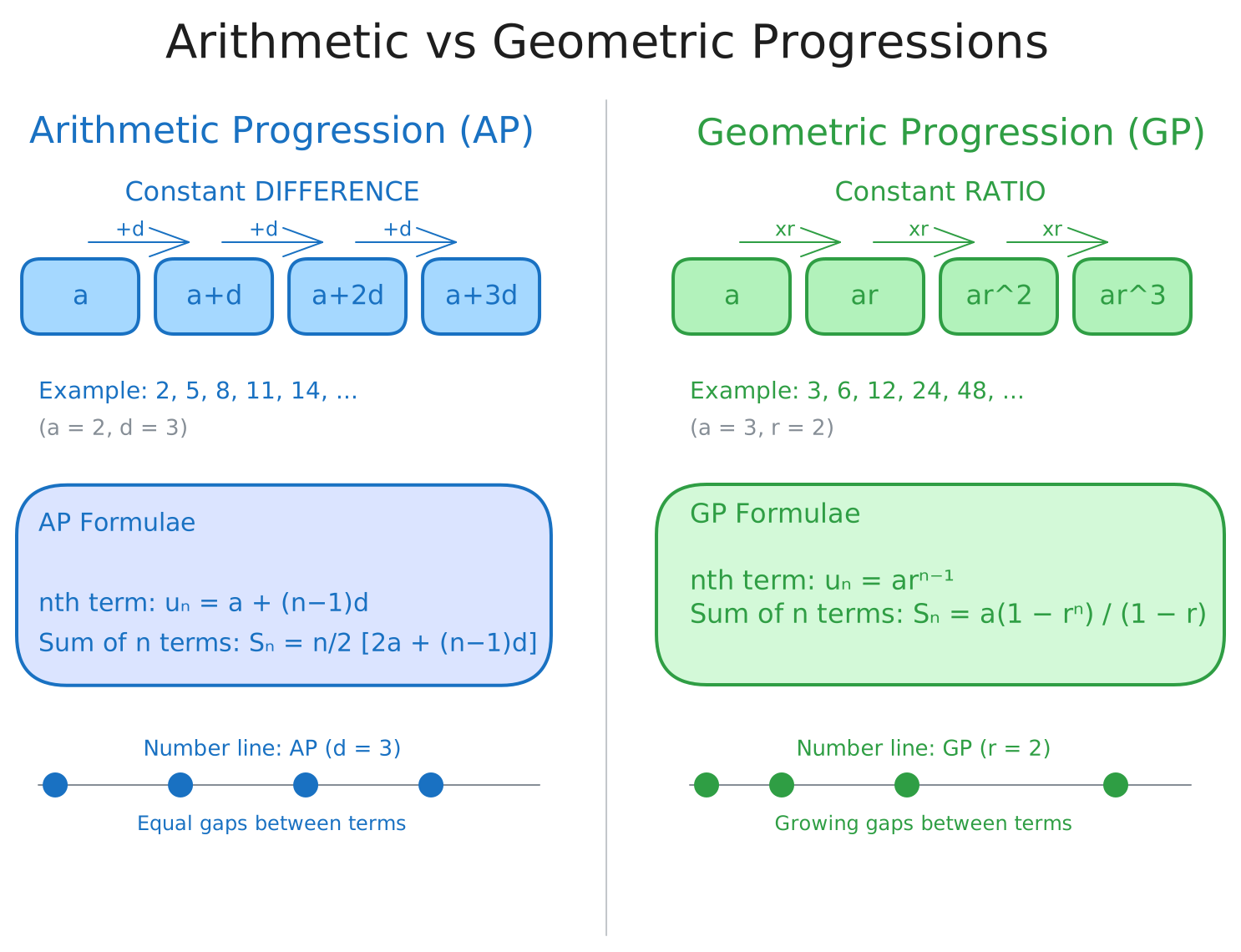
Six formulae across two progression types. The key distinguisher: AP uses addition (add d each time), GP uses multiplication (multiply by r each time). If you find yourself writing a + (n−1)r or arⁿ⁻¹d, stop — you've crossed the streams. Drill them in pairs: AP nth term with GP nth term, AP sum with GP sum.
Sign errors in (a − b)ⁿ binomial expansions
In (1 − 2x)⁴, treat b as (−2x), so each term includes (−2x)ʳ. When r is odd, the term is negative; when r is even, positive. Students who write (2x)ʳ without the negative sign lose the alternating pattern entirely. Sign errors in (a − b)ⁿ expansions are one of the most frequently penalised mistakes in binomial questions — always write (−2x)ʳ with brackets at every step to avoid losing the sign.
Not translating word problem conditions into equations before solving
When a question says 'the 3rd term is 12', your first action is to write ar² = 12 (GP) or a + 2d = 12 (AP). Students who try to solve in their heads without writing the equations make algebraic errors. Two conditions about the sequence give you two equations. Write them both down, then solve systematically.
Exam Tips
AP vs GP: How to Tell Which You Have
Six formulae across two progression types, plus sum to infinity. Under exam pressure, students reach for the wrong one. The distinction is simple: check whether the difference between consecutive terms is constant (AP) or the ratio is constant (GP).
| Property | Arithmetic Progression (AP) | Geometric Progression (GP) |
|---|---|---|
| Pattern | Each term adds a constant difference d | Each term multiplies by a constant ratio r |
| Test | u_2 - u_1 = u_3 - u_2 (constant?) | u_2/u_1 = u_3/u_2 (constant?) |
| nth term | u_n = a + (n-1)d | u_n = ar^(n-1) |
| Sum of n terms | S_n = n/2(2a + (n-1)d) | S_n = a(1 - r^n)/(1 - r) |
| Sum to infinity | Does not exist (diverges unless d = 0) | S_inf = a/(1-r), only if |r| < 1 |
| Key operation | Addition | Multiplication |
Binomial Expansion: Which Method to Use
Two tools, two situations. Pascal's triangle is fastest for writing out the full expansion of (a + b)^n when n is small (up to about 6). The general term formula is what you need when the question asks for a specific coefficient, a specific term number, or the term independent of x.
For fractional or negative n, that's Pure 3 — not in scope for Paper 1. If a question on Paper 1 involves binomial expansion, n will always be a positive integer.
Sign Tracking in (a - b)^n
When expanding (a - b)^n, the signs alternate. The trick is to treat b as (-b) and raise (-b) to the rth power at every step. Even powers give positive terms; odd powers give negative terms. Write (-b)^r with the brackets every time and the signs take care of themselves.
The Convergence Condition for Sum to Infinity
The sum to infinity formula S = a/(1-r) only works when |r| < 1. When each successive term gets smaller (because |r| < 1), the partial sums approach a fixed value. When |r| >= 1, the terms don't shrink and the partial sums grow without bound -- no finite sum exists.
Setting Up Simultaneous Equations from Sequence Conditions
Many 9709 series questions give two conditions about a sequence and expect you to form two equations then solve simultaneously. This is where students lose the most marks -- not on the algebra, but on the translation from words to equations.
Revision Strategy for Series
Stage 1 -- Memorise all formulae (Days 1-2). Use flashcards. You need instant recall of all six AP/GP formulae plus the binomial theorem. None of them are on the formula sheet.
Stage 2 -- Drill binomial coefficient questions (Days 3-5). Focus on 'find the coefficient of x^r' and 'term independent of x' questions. Get the mechanical process automatic.
Stage 3 -- Practise AP/GP equation setup (Days 6-8). The algebra is straightforward once you have the equations. Spend your time on translating word problems into simultaneous equations.
Stage 4 -- Timed past papers (Days 9+). Practice full series questions under exam conditions. Mark using the official mark scheme to learn what examiners actually award marks for.
Practice series questions with AI-powered questions calibrated to your level
ExamPilot identifies your weak spots and targets them with adaptive practice.
Join the WaitlistFrequently Asked Questions
Reviewed by
AI-assisted, human-reviewed